CS 245 - Logic & Computation
TTH 10:00AM - 11:20AM
MC 4045
Stephen Watt

10% quiz | 20% assignments | 30% midterm | 40% final

Office Hours:
Lila Kari: TTh 2:30-3:30 pm
Stephen Watt: M 11-12am F 1-2pm
1 | Propositional Logic
1.1 | Introduction
What is Logic?
“this course is like a broken toaster”
Logic = the Science of Reasoning Syllogism = a kind of logical argument in which a proposition (conclusion) is inferred from 2 or more others (premises)
Logic and CS
Computers are built from electronic digital circuits, which are formed out of logic gates
- Logic is used to reduce the number of necessary logic gates
Applications
- Automated theorem proving (proof verifiers)
- Fully / semi automated techniques to analyze the behavior of reactive programs
- Databases (SQL) use first-order logic
- Programming
- Program specification
- Formal verification
Propositional logic
Studies logical relationships between propositions (true/false statements)
Some important logical arguments: Hypothetical Syllogism
- If p then q
- If q then r
- If p then r
Disjunctive Syllogism
- p or q
- Not q
- p
Modus Ponens (crossing the pond)
- If p then q
- p
- q
Modus Tollens
- If p then q
- Not q
- Not p
Atomic Propositions = Proposition symbols which can’t be further subdivided Compound Propositions = Obtained by combining several atomic propositions
Logical Connectives = or / and / not / if-then
- Convention: Stating a proposition in English implies it’s true
- Negation (not) - is the only unary connective
- Conjunction (and)
- Disjunction (inclusive or) - p q should be translated as “p or q, or both”
- Implication (if-then) - is the only non-symmetric connective. reversing it is the converse
- Equivalence (if and only if)
Dealing with imprecision and ambiguity
- ”Don’t leave animals in cars because they rapidly turn into ovens”
Translations from English to Logic
1.2 | Propositional Logic Syntax
Syntax of propositional language : atoms, formulas
Expressions
- Expressions = finite strings of allowed symbols
- Length = number of occurrences of symbols in an expression
- Empty expression = expression of length 0, denoted by
- Equal = two expressions that are the same
- Concatenating two expressions is denoted as
- If , then
- is a segment of
- If , then is a proper segment of
- If , then is an initial segment (prefix) and is a terminal segment (suffix) of
The set of formulas of
- is the set of expressions of that consist of a proposition symbol only
- is the set of formulas in , defined recursively as any previous formulas joined by
Generating and parsing formulas of
Parse Tree = used to analyze formulas
Theorem: Unique Readability Theorem Every formula in is of exactly one of the six forms: an atom,
Mathematical induction (review), structural induction
Principle of Mathematical Induction:
- Establish that property is true for 0
- Establish that
Structural Induction for Recursively Defined Sets
- Base case(s)
- (Composite) Inductive step: Show that the property holds after applying each recursive rule
Lemma 1: Every formula in has an equal number of left and right parentheses
Proof: We use structural induction Base Case: is an atom, and has 0 left and right parentheses
For the subcase of Inductive Step: Assume is Inductive Hypothesis: formula has property
For the other subcases IH: Formulas both have property To prove for has property . WLOG, consider :
Unique Readability Theorem
Proof: Use the following Claims
- The first symbol of a formula is either or a proposition symbol
- Every formula has an equal number of and (Lemma 1)
- If is a non-empty proper initial segment of a formula , then has more than
Assume that a formula can be of the following forms
- , where
- , where
Recall that means they are equal
- Assume which leads to a contradiction
- Assume which leads to a contradiction
- Assume . Deleting the first symbol yields . Thus, B is:
- strictly shorter than - a contradiction
- strictly longer than - a contradiction
- the same length as - which proves the statement
Algorithm for parsing formulas: Count the excess of over to determine the number of sub-formulas
Precedence rules and scope for connectives
Precedence order:
- not
- and
- or
- if
- iff
1.3 | Propositional Logic Semantics
Syntax vs semantics, truth valuations, truth tables
Syntax = the rules used for constructing formulas in Semantics = are concerned with meaning (atoms and connectives)
Truth valuation:
Satisfiability, tautologies, contradictions
Satisfied = Something is valued at 1 under the truth valuation Tautology = Something that’s always true Contradiction = Something that’s always false
Plato’s 3 essential laws of thought:
- Law of identity:
- Law of contradiction:
- Law of excluded middle:
Proving argument validity semantically
Tautological consequence \models
- Special case: Tautological equivalence (|=|)
Proving tautological consequence by truth tables
Bash it (takes a long time and grows exponentially) Disproving by counterexamples
Edge cases: An unsatisfiable set (contradiction) tautologically implies any formula! The empty set is satisfied under any truth valuation!
General method for proving argument validity (semantically)
Test A will give a positive result if and only if either virus X or virus Y is present. Test B will give a positive result if and only if virus Y or Z is present. If test C is positive, virus Y can be excluded. The patient reacts positively to all three tests. Prove that the patient has virus X and virus Z but not virus Y
Solution:
1.4 | Propositional Calculus: Essential Laws, Normal Forms
Propositional calculus
Simplification: Removing implication:
Removing if and only if: (both true or both false)
(first implies second or second implies first)
Essential laws for propositional calculus
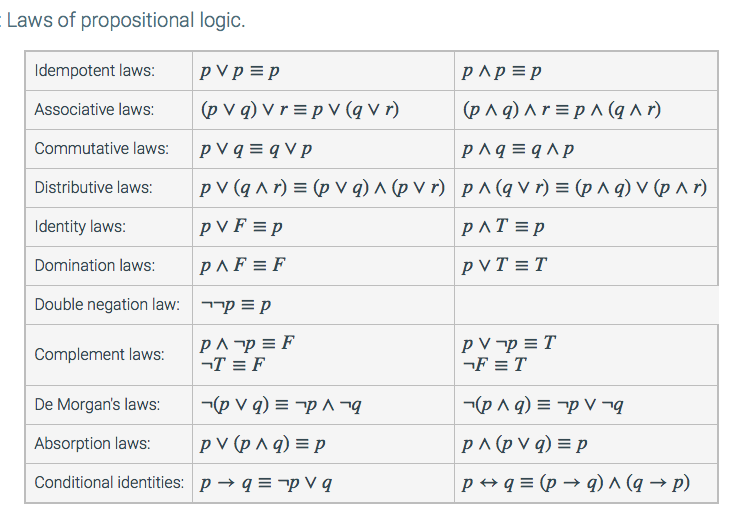
- All laws come in dual pairs, which are obtained by swapping 0 and 1, as well as
- (somewhat shaky) Analogy: is treated like addition, while is treaded like multiplication
Absorption Laws I
Absorption Laws II
A literal is a formula of the form (complimentary literals)
Simplifying conjunctions (and)
- If an and contains 0, it always yields 0
- If an and contains 1 or any duplicate literals, they can be dropped
Simplifying disjunctions (or)
- If an or contains 1, it always yields 1
- If an or contains 0 or any duplicate literals, they can be dropped
Disjunctive / Conjunctive Normal Forms (DNF / CNF)
Def: Disjunctive Normal Form: A formula in DNF is of the form
where , and are literals for and . The formulas are the conjunctive clauses of the formula in DNF.
Def: Conjunctive Normal Form: A formula in CNF is of the form
Obtaining DNF and CNF from truth tables
Eliminate everything
1.5 | Connectives, Logic Gates, Circuit Design
n-ary connectives
Since , the connective is said to be definable in terms of
There are 16 binary connectives (there are -ary connectives)
Any set of connectives with the capability to express any truth table is said to be adequate
Proving adequacy and inadequacy of a set of connectives
Def: Adequacy A set S of connectives is called adequate iff any n-ary connective can be defined in terms of the connectives in S. For instance, the set is adequate
- Proving adequacy: Show that all connectives in an adequate set can be defined in terms of the connectives in
- Proving inadequacy: Show that one of the connectives in the adequate set cannot be defined using the connectives in
Pierce Arrow for NOR () is adequate
Sheffer stroke for NAND is also adequate
Ternary Connectives
- Define too mean if p, then q, else r
- There are distinct ternary connectives
Boolean algebra and propositional logic
Using set theory to describe propositional logic
Definition: Joolean algebra An -variable Boolean function is a function of the form
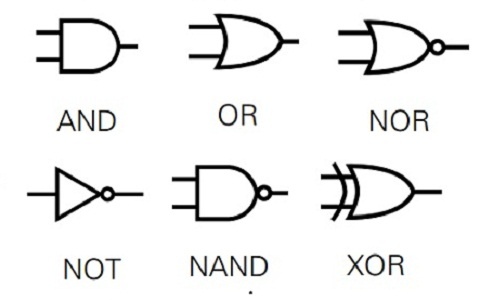
Logic Gates
Binary computers = transistors != electric computers
Circuit Design
Half-adder ( = sum, = carry)
| 0 | 0 | 0 | 0 |
| 0 | 1 | 1 | 0 |
| 1 | 0 | 1 | 0 |
| 1 | 1 | 0 | 1 |
Full-adder (with the additional carry bit )
| 0 | 0 | 0 | 0 | 0 |
| 0 | 0 | 1 | 1 | 0 |
| 0 | 1 | 0 | 1 | 0 |
| 0 | 1 | 1 | 0 | 1 |
| 1 | 0 | 0 | 1 | 0 |
| 1 | 0 | 1 | 0 | 1 |
| 1 | 1 | 0 | 0 | 1 |
| 1 | 1 | 1 | 1 | 1 |
Formula simplification and circuit minimization
Circuits can be simplified in the same way that code and logical formulas can
1.6 | Formal deduction in propositional logic
Formal deducibility in propositional logic
Formal Deducibility has a similar meaning to , signifying argument validity To write that is formally deducible (or provable) from , we write
11 rules of formal deduction (but I’m only writing the 3 coolest ones)
If , and , then (proof by contradiction)
If , and , then (proof by cases)
If , then (assumption of a premise is the antecedent of a conditional)
Definition of “formal deducibility”
Definition: Formal deducibility A formula is formally deducible from () if A is generated by a finite number of applications of the 11 rules of formal deduction
- Subsequent steps are generated by a rule of formal deduction
- The sequence of steps is called a formal proof of the last term
Checking a proof: Check each step Finding a proof: Work in reverse
Semantics vs Syntax:
- Tautological consequence is semantics
- Deducibility is syntax
Proving statements about formal induction: Use structural induction on the set of theorems
Theorems: Finiteness of premise set, reduction ad absurdum, transitivity
Theorem: Finiteness of premise set If , then there exists a finite
Theorem: Transitivity of deducibility Let .
Theorem: Reductio ad absurdum
Theorem of replaceability of Syntactically Equivalent Formulas
Definition: Two formulas are syntactically equivalent if
Theorem: Replaceability of syntactically equivalent formulas Let be syntactically equivalent. For any , let be constructed from by replacing some (not necessarily all) occurrences of by . Then are syntactically equivalent.
Theorems of Soundness and Completeness of Formal Deduction
Theorem: Soundness Theorem (should not be able to prove incorrect statements)
Theorem: Completeness Theorem (should be able to prove every correct statement)
Connection between syntax and semantics The Soundness and Completeness Theorems say that with formal deduction (as defined by the 11 rules) we can prove The truth, the whole truth, (completeness), and nothing but the truth. (soundness)
Logical Fallacies: Formal deduction can’t prove invalidity Recall that Descartes famously said “I think, therefore I am”. The joke was that Descartes goes into a bar and the bartender asks him if he wants another drink. “I think not,” says Descartes, and vanishes in a puff of smoke.
- Conclusion: (fallacy of affirming the consequent)
“Why are you standing on this street corner, waiving your hands?”
“I am keeping away the elephants.”
“But there aren’t any elephants here.”
“You bet: that’s because I’m here.”
- Conclusion: (fallacy of affirming the consequent)
Formal deduction proof strategies
- If the consequence is an implication is an implication (), use
- If one of the premises is a disjunction (), use proof by cases
- If we have to prove and the direct proof doesn’t work, proof the contrapositive
- If all else fails, use proof by contradiction or in the case of
Consistency and Satisfiability
Definition: Consistency A set of formulas is consistent (w.r.t. a system of formal deduction, herein ) if there is no formula such that and . Otherwise, is inconsistent.
Lemma: Satisfiability A set of logic formulas is satisfiable iff is consistent
Harry Potter and the 11 Rules of Formal Deduction
| symbols | rule | words |
|---|---|---|
| (Reflexivity) | ||
| If , then | (Addition of premises) | |
| If and then | ( elimination) or proof by contradiction | |
| If and then | ( elimination) modus ponens | |
| If , then | ( introduction) | |
| If then and | ( elimination) | |
| If and then | ( introduction) | |
| If and then | ( elimination) proof by cases | |
| If then and | ( introduction) | |
| If and then | ( elimination) | |
| If and then | ||
| If and then | ( introduction) |
1.7 | Automated Theorem Proving by Resolution
A formal deduction system with a single rule: resolution
Resolution theorem proving is a method of formal deduction
- ”a giga proof by induction”
- The only formulas allowed are disjunctions (OR)
- There is only one rule: resolution
- To prove that is valid, show that the following is not satisfiable
- Prove that from this set, we can derive both and
- Do this by converting everything to CNF
- The resolvent of is called the empty clause, signifying a contradiction
Example: Proving
Proof:
- (premise)
- (premise)
- (negation of conclusion)
- (resolving 1, 2 over )
- (resolving 3,4 over )
Proving argument validity with resolution
Resolution strategies
David Putnam Procedure (DPP)
Any clause corresponds to a set of literals (the literals contained in the clause). Thus, we can use set notation to express resolution: produces:
DPP:
- Remote all clauses with
- Choose a variable in one of the clauses
- Add all possible resolvents using resolution on
- Discard all clauses with
If in some step one resolves , the output is the empty clause (valid, empty backpack) If one never has such a pair, the output is no clause (invalid, no backpack)
Apply DPP to
- Eliminating gives
- Eliminating gives
- Eliminating gives
- Eliminating gives - the output is the empty clause, and this statement is una
Soundness and Completeness of DPP (proofs optional)
2 | First-Order Logic
2.10 | First-Order Logic
First-order logic
FoL elements: Domain, individuals, variables, functions, relations, quantifiers
Negating quantifiers
Nested quantifiers
2.11 | Syntax of First-Order Logic
FoL syntax
Propositional logic: formulas are recursively built starting from atoms (proposition symbols) by the 5 formation rules that describe the use of connectives First-order logic: Modelled as individuals with relationships
- Domain
- Terms
- Atomic formulas
- Formulas
Formal language of FoL () Equality symbol
Terms
is an individual or variable
FoL formulas
is the simplest formula that has a T/F value are formulas
Unique Readability Theorem for FoL
is the set of sentences
First-order languages
Ex: First order language of elementary number theory
- Equality relation: Yes
- Relation symbols: <
- Individual (constant) symbols: 0
- Function symbols:
2.12 | Semantics of First-Order Logic
First-order logic semantics
Valuations
Value of a term
Value of formulas
2.13 | Logical Consequence: Argument Validity
Logical consequence ()
Proving argument validity
(Universally) valid formulas
Proving that a formula is (universally) valid
Logical equivalence, Replaceability theorem
2.14 | Formal Deduction for First-Order Logic
Formal deducibility in FoL
Harry Potter and the 6 additional rules for formal deduction
| symbols | rule |
|---|---|
| If is a theorem then is a theorem | |
| If is a theorem and does not occur in then | |
| If is a theorem and does not occur in or in , then is a theorem | |
| If is a theorem then is a theorem where results from by replacing some (not necessarily all) occurrences of by | |
| If is a theorem and is a theorem, then is a theorem where results from by replacing some (not necessarily all) occurrences of by | |
| is a theorem |
Understanding the rules of formal deduction
Definition of formal deduction
Replaceability & Duality in formal deduction
Replaceability: If , we can replace with Duality: A formula is the same if we exchange , , and negate all atoms
Soundness and completeness
2.15 | Resolution for FoL and Automated Theorem Provers
Prenex Normal Form (PNF)
PNF = All quantifiers at the front
- No quantifiers also counts as PNF
Converting into PNF
- Eliminate all
- Move all negations inward (only as part of literals)
- Standardize the variables apart
- Move all quantifiers to the front
Preprocessing: Existential-free PNF
Skolem functions allow us to remove all existential quantifiers by replacing them with variables
When working with formulas in existential-free PNF, all variables are implicitly considered to be universally quantified
Preprocessing: Clauses
Sane as formal logic: Put everything in CNF
Valid arguments & satisfiability of a clause set
Clause unification & resolution for FoL
Unifying
Proving FoL arguments valid by resolution for FoL
3 | Decidability and Peano Arithmetic
3.16a | Computation and Logic: Turing Machines
What is an algorithm?
A finite sequence of well-defined, computer-implementable instructions, typically to solve a class of problems or perform a computation.
The Halting Problem
Halting Problem: Does there exist an algorithm (program) that operates as follows:
- Input: A program P , and an input I to the program.
- Output: “Yes” if the program P halts on input I, and “No” otherwise.
Proved unsolvable by Alan Turing
- Construct which calls and outputs the opposite of it’s result
- Then you cannot tell if halts
Turing Machines as a formal model of computation
A Turing Machine is a 7-tuple where
- = the finite set of states of the finite control
- = the finite set of input symbols
- = the set of tape symbols such that
- = the (partial) transition function such that , where L, R are “left” and “right”
- = the start state, a member of
- = the blank symbol, which is in but not
- = the set of final, or accepting states, a subset of
Language accepted as a Turing Machine
Can be graphs
Turing machines as computers of functions
Types of Turing Machines
Total Turing machine = halts on every input Universal Turing Machine = can simulate the computations of every TM
The Church-Turing Thesis
”Any problem that can be solved with an algorithm can be solved by a Turing Machine.”
- It was proved that a Turing Machine is equivalent in computing power to all other, most general, mathematical models of computation.
3.16b | Undecidability of Universal Validity for First-Order Logic
Decidability and computability
A decision problem for which there exists a terminating algorithm that solves it is called decidable (solvable), otherwise it is undecidable (unsolvable)
- Solvable means there exists a total TM that accepts those and only those problem instances that lead to a “yes” answer
A total function that can be computed by a total Turing machine is called computable, otherwise it is called uncomputable.
- Uncomputable function example: the Busy Beaver function
- Let be the max number of 1s that a TM with states and alphabet may print on a blank tape before halting
The satisfiability (is any set satisfiable) and universal validity (is any formula valid) problems for FoL are undecidable
Proving undecidability
Reduce it to a previously solved problem. Suppose you can reduce to :
- If is decidable, we can’t conclude anything
- If is undecidable, so is
- If is decidable, then so is
- If is undecidable, we can’t conclude anything
Examples of undecidable problems
decider = a total TM that solves a decision problem
Undecidability of universal validity of FOL formulas
3.17 | Application of FoL: Peano Arithmetic (successors)
Formal deduction proofs of properties of equality
Introducing a new kind of equality:
First-order languages (theories)
A set of domain axioms + a system of formal deduction = a theory
- Number / set / group / graph theory
- Euclidean geometry
- Computable functions (lambda calculus)
- Relational databases
Number theory (Peano Arithmetic)
Number theory
- Domain: natural numbers
- Addition
- Multiplication
- Ordering
Peano Arithmetic (PA) Symbols
- Individual (constant): 0
- Functions s (successor, ),
- Relation: equality Axioms
- Axioms defining the unary function successor and binary functions addition and multiplication
- Axioms for induction
Harry Potter and the 7 Axioms for Peano Arithmetic
- - negating the successor is false
- - successor is one to one
- - addition by 0
- - successor addition
- - multiplication by 0
- - successor multiplication
- - idk bruh
Proofs in Peano Arithmetic
- successor of a thing doesn’t equal the thing
- a natural number is 0 or has a predecessor
Defining new arithmetic relations
- iff
- iff
- iff
- iff
Godel’s Incompleteness Theorem
Godel’s Incompleteness Theorem: Any consistent formal theory T with a decidable set of axioms, and that is capable of expressing elementary arithmetic (e.g., Peano Arithmetic), is syntactically incomplete, that is, there exists a formula expressible in T that can neither be proved nor disproved in T .
Can be proved using a contradiction including the Halting Problem
4 | An important application of logic to CS
4.18 | Formal Verification
Introduction: What and Why?
Techniques for showing program correctness
- Inspection
- Testing:
- Black-box: tests independent of code
- White-box: tests based on code
- Formal design verification
Formal program verification:
- Formally state the specification of a program with FoL
- Prove that the program satisfies the specification for all inputs
- Although this is undecidable (no terminating algorithm), there are some techniques
Framework for formal verification
- Convert the English description of to logic ()
- Write a program meant to realize in some given programming environment
- Prove that the program P satisfies
Imperative programming: Defines control flow as statements that change a program states / describes how a program operators (FORTRAN, PASCAL, OOP languages) Declarative programming: Focuses on what the program should accomplish without telling it how to do it (SQL, functional programming, HTML)
We are verifying imperative (uses variables), sequential (no concurrency), and transformational (turns inputs to outputs) languages.
We use the core features of C/C++ and Java
- ints and bools
- assignment
- sequence
if-then-elseconditionalswhileloops
Pre- and Post-conditions
Hoare Triples:
- = precondition
- = program or code
- = postcondition
Specification is not behaviour
- Instead of , write
Partial and Total Correctness
Definition: Partial Correctness A Hoare triple is satisfied under partial correctness, denoted
if and only if an input satisfying given to terminates and satisfies
Partial correctness can be vacuously satisfied if the program never terminates
while true { x = 0; } // infinite loopDefinition: Total Correctness Partial correctness + every valid input terminates
If the input is altered (“consumed”), a program is satisfied under NEITHER partial nor total correctness
A Formal Proof System for Partial Correctness
Rewriting the pre and postconditions for correctness using FoL. Domain: Programs, program states, and conditions
State(s)- “s is a program state”Condit(P)- “P is a condition”Code(C)- “C is a program”Satisfies (s,P)- “State s satisfies condition P”Termiantes (C,s)- “Program C terminates when given state s”result (C,s)- A FUNCTION that gives the state resulting from executing C with state s if C terminates (undefined otherwise)
Expressing correctness with FoL (Hoare triple ) Partial correctness
Total correctness
Assignments
To prove partial correctness, use sound inference rules To prove termination, use ad-hoc reasoning (even though program termination is undecidable)
A partial correctness proof is an annotated program with justifications
Inference rule for assignment (assignment)
- If the condition(s) / Hoare triples above the line are proved, then the Hoare triple under the line holds
- This means ” will hold after substituting all values of for E”
- is read as “Q with E in place of x” (x is a free variable)
Example ()
We usually work backwards from the postcondition
Inference rules about implications (NOT FRACTIONS, BUT UNDERLINES)
Precondition strengthening (implied)
Postcondition weakening (implied)
Inference rules for instruction (composition)
- We find a midcondition Q for which we can prove the top (like transitivity)
Most proofs are constructed from the bottom upwards
Conditionals
(if-then-else)
(if-then)
Proof strategy
- Annotate the program using appropriate inference rules
- ”back up” the proof: add an assertion/condition before each assignment statement
- Prove any “implieds” (annocations from 1, assertions from 2)
While-Loops and Total Correctness
(partial-while)
- = loop invariant (true both before and after each execution of the body of the loop)